Razer AIKit Now Sees, Hears, and Generates Images: What It Means for Project AVA (Razer AVA)
Razer's local AI toolkit just received its biggest update yet. Razer AIKit goes omni-modal — text, image, video, and audio — and adds support for ARM64 architectures. What used to be just chat can now see, listen, and create.
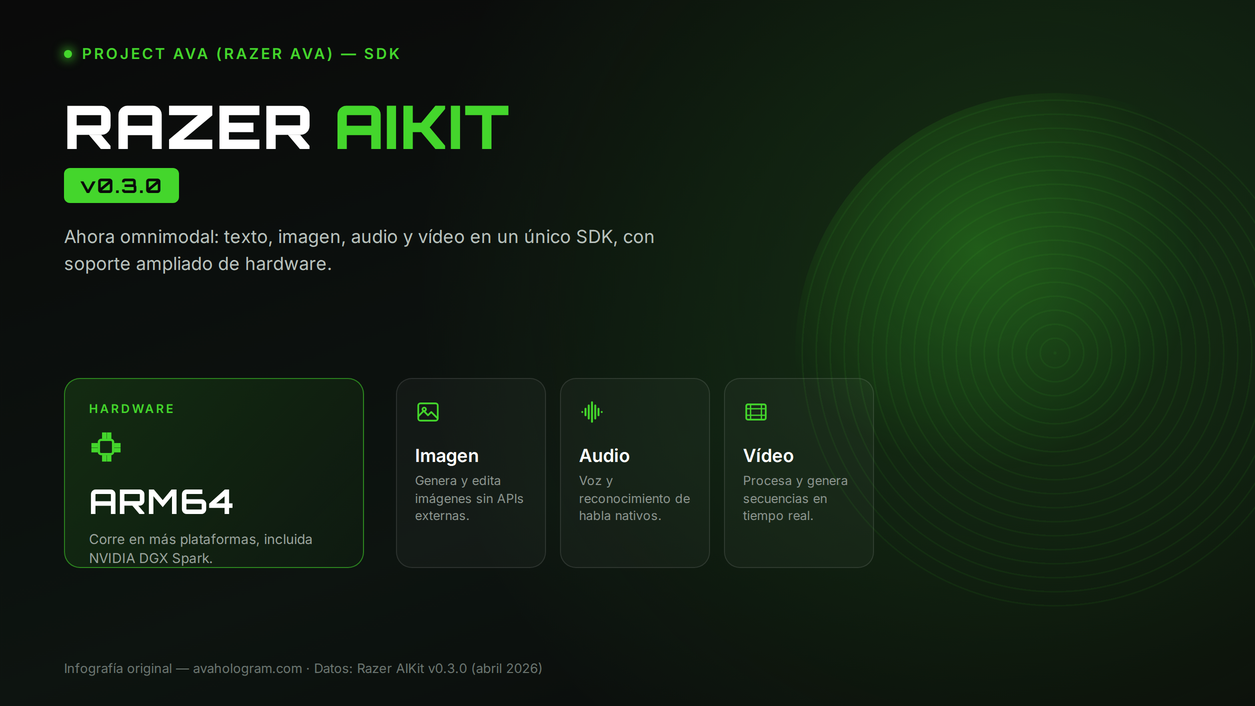
Razer AIKit is Razer's free, open-source AI development toolkit for running and fine-tuning AI models locally. It isn't exclusive to Project AVA (Razer AVA) — it's a separate AI initiative from the same maker — but Razer has already put it to work in production within the AVA ecosystem, for example powering the image generation behind the AVA Mini campaign. Until now, it worked primarily with text. With this update, the toolkit takes a significant leap: it natively supports image, video, and audio models, and can run on a much wider range of hardware.
What Does "Omni-Modal" Actually Mean?
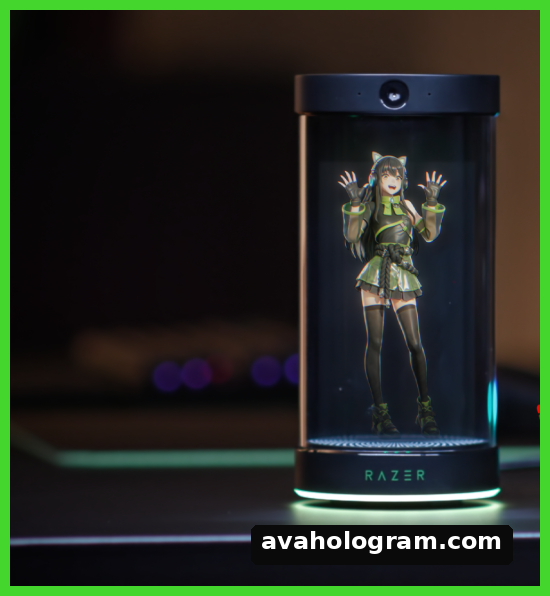
Until recently, AI models tended to specialize: text models processed text, image models processed images. An omni-modal system unifies those capabilities into a single consistent workflow. For Project AVA (Razer AVA), this matters because the device already includes visual and audio sensing — the cameras and microphones that let AVA "see" your screen and "hear" you.
With omni-modal AIKit, ecosystem developers can now build avatars and behaviors that respond coherently to what AVA sees, hears, and reads — without having to manually wire together multiple separate models. Everything flows through one consistent toolkit.
Image Generation
AIKit can generate and manipulate images directly, without relying on external APIs. AVA Mini proved it: over 11,000 avatars generated in 4 days.
Audio Models
Native support for voice synthesis and recognition models. AVA can listen and respond with its own voice without additional integration layers.
Video Models
Ability to process and generate video sequences. Relevant for hologram animations and real-time visual responses.
ARM64 & Broader Hardware
AIKit now runs on ARM64 architectures, including NVIDIA DGX Spark platforms. Greater flexibility for both local development and cloud deployment.
The Real-World Proof: AVA Mini by the Numbers
Razer didn't present this update in the abstract. They already stress-tested it in production during the AVA Mini campaign (March 31 – April 4, 2026), where the toolkit generated personalized pet avatars from user-uploaded photos.
11,000+
images generated
3.24s
average latency
15×
lower cost vs. standard cloud
The deployment ran on Akash Network's distributed GPU grid, bringing inference costs down to $0.01 per image — up to 15 times cheaper than standard cloud APIs. Razer was explicit: the campaign was also a real stress test of their AI infrastructure.
Our Take
What matters most about this update isn't the feature list — it's that AVA Mini already proved these features work at real scale, not just in a controlled demo. 11,000 images generated over four days at 3.24 seconds of average latency and 15 times cheaper than a standard cloud API are production numbers, not lab numbers. That changes the conversation: the question is no longer whether omni-modal AIKit works, but what developers will build now that they have that cost margin to play with.
Our take is that ARM64 support is the most important piece over the medium term, even though it sounds less flashy than "generates images and video." It widens the range of hardware AIKit can run on locally — from NVIDIA DGX Spark workstations down to more modest devices — which is the necessary condition for Razer to actually deliver on its privacy promise without forcing users to buy high-end hardware. The risk is fragmentation: if the quality of a locally-generated avatar depends on whoever's hardware is running it, the experience stops being uniform across users.
The free, open-source bet is consistent with that reading: Razer needs a community of developers building avatars and behaviors, not an internally-managed closed catalog. But open source and monetization aren't mutually exclusive — it wouldn't be surprising to eventually see an official marketplace for third-party creations with revenue sharing, once the ecosystem reaches critical mass.
What This Means for the End User of Project AVA (Razer AVA)
As a device owner, you don't need to understand the toolkit internals. What matters is what omni-modal AIKit makes possible in practice:
- More expressive avatars. The hologram can react to what it hears and sees in real time with greater coherence, because all models speak the same language.
- A larger developer ecosystem. By supporting ARM64 and reducing inference costs, more independent developers can build on top of Razer's local AI ecosystem.
- Today's experiments, tomorrow's features. AVA Mini was a prototype. Capabilities like generating personalized visual content in seconds have a clear path to the final product.
AIKit Is Free and Open Source
Razer maintains AIKit as an open-source project on GitHub, with active support from their engineering team. Any developer can download it, run it on their own hardware — no cloud subscription required — and contribute to the AVA ecosystem.
This open-source commitment is deliberate: Razer wants the local AI ecosystem around AVA to grow organically, much like what happened with mod-friendly gaming platforms. The technical foundation for that to happen just became considerably more powerful.
When Does Project AVA (Razer AVA) Launch?
The official Project AVA (Razer AVA) launch is scheduled for the second half of 2026. Check dates and available regions.