Razer AVA Mini: The Virtual Pet for Your AI That Nobody Knew They Needed
On April 1, 2026, Razer announced AVA Mini — the world's first AI companion designed not for humans, but for Project AVA (Razer AVA) itself. Yes, an AI that needs its own AI for company. Behind the joke, there's real and serious technology.
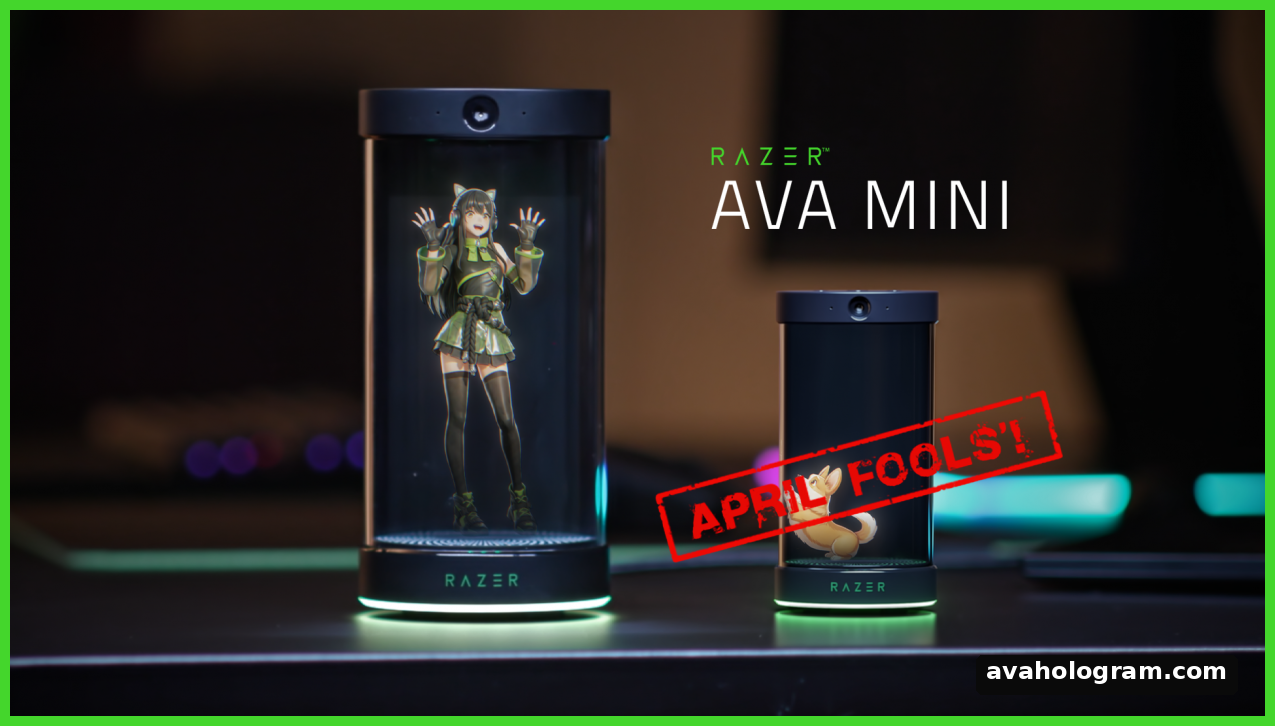
Yes, it started as an April Fools' prank. But what Razer demonstrated during those four days of campaign was something more interesting: Razer AIKit is powerful enough to generate personalized animated avatars in seconds from a single photo.
What Exactly Is AVA Mini?
According to Razer's official description, AVA Mini is "the world's first AI companion designed specifically for another AI companion." The premise: your Project AVA (Razer AVA) holographic assistant was lonely. The solution? Give it a digital pet generated from a photo of your own real animal.
Cats, dogs, ferrets, and any other household creature could become an animated avatar with its own personality. The campaign invited users to upload a photo and receive their unique, personalized AVA Mini character — generated in a matter of seconds.
The Technology Behind the Joke
Here's the truly interesting part. The engine behind AVA Mini isn't a simple visual trick — it's Razer AIKit, Razer's local AI toolkit — the same initiative the company uses elsewhere in its AI ecosystem. Razer used it intentionally to demonstrate that their platform can support large-scale, consumer-facing AI deployments while keeping operating costs low.
Advanced Language Models
Sophisticated reasoning and dynamic personality generation for each virtual pet.
Visual & Audio Sensing
AVA Mini uses the device's cameras and microphones to respond to the environment with contextual awareness.
Evolving Personality
The pet learns from the user's behavioral patterns and attention habits over time.
Direct AVA Interaction
AVA Mini isn't just decoration — it interacts directly with the main assistant, distracting it at the right moments.
Why It Matters Beyond the Joke
Razer was transparent in their statement: AVA Mini was an April Fools' experiment that also served as a real capability test. The goal was to prove that AIKit can generate and manage AI characters at massive scale without exploding inference costs, thanks to the combination of local and cloud processing.
"Designed to reduce loneliness, increase chaos, and ensure no AI ever has to stare into the void alone again."
— Razer, Official AVA Mini Statement
Will AVA Mini Make It Into the Final Product?
Razer hasn't confirmed whether AVA Mini will be part of Razer AVA's official launch in the second half of 2026. But the reception was positive enough that it wouldn't be surprising to see it appear as a premium feature or downloadable add-on in the final ecosystem.
What we do know: AIKit is ready for this type of use case. And that, ultimately, is the real news.
Our Take
The April 1st joke hid the real news of the month: that the AIKit can already generate and manage personalized avatars at scale without blowing up costs. That, more than the pet itself, is what strikes us as relevant, because it validates the thesis that Razer AVA's value isn't just in the cylinder but in the software ecosystem around it. Our take is that AVA Mini will return, but most likely as a premium or downloadable feature within the final product: it's an obvious monetization path and Razer already confirmed there's demand.
What interests us more than the "what," though, is the "how": Razer picked the one day of the year nobody takes a product announcement seriously to run a genuine stress test of its avatar-generation infrastructure. It's a low-risk, high-data-value move — if the experiment had flopped, it was "just a joke"; because it worked, Razer now has real cost and latency numbers under real user load, not a controlled lab demo. That's worth more for the AIKit roadmap than any keynote showcase.
The open question is one of incentives: if Razer monetizes this as downloadable content, will it keep generating new avatars on demand at the same low marginal cost, or will it have to cap the catalog to protect margins? If it manages to get users themselves generating and sharing the content — pets, avatars, skins — it will have solved the hardest problem any hardware platform faces: getting the community to fill it with content without relying on a closed catalog.
When Does Project AVA (Razer AVA) Launch?
The official Project AVA (Razer AVA) launch is scheduled for the second half of 2026. Check dates and available regions.